
The Underworld Goddesses: Ancient Wisdom for the Season of Descent
Oct 09, 2026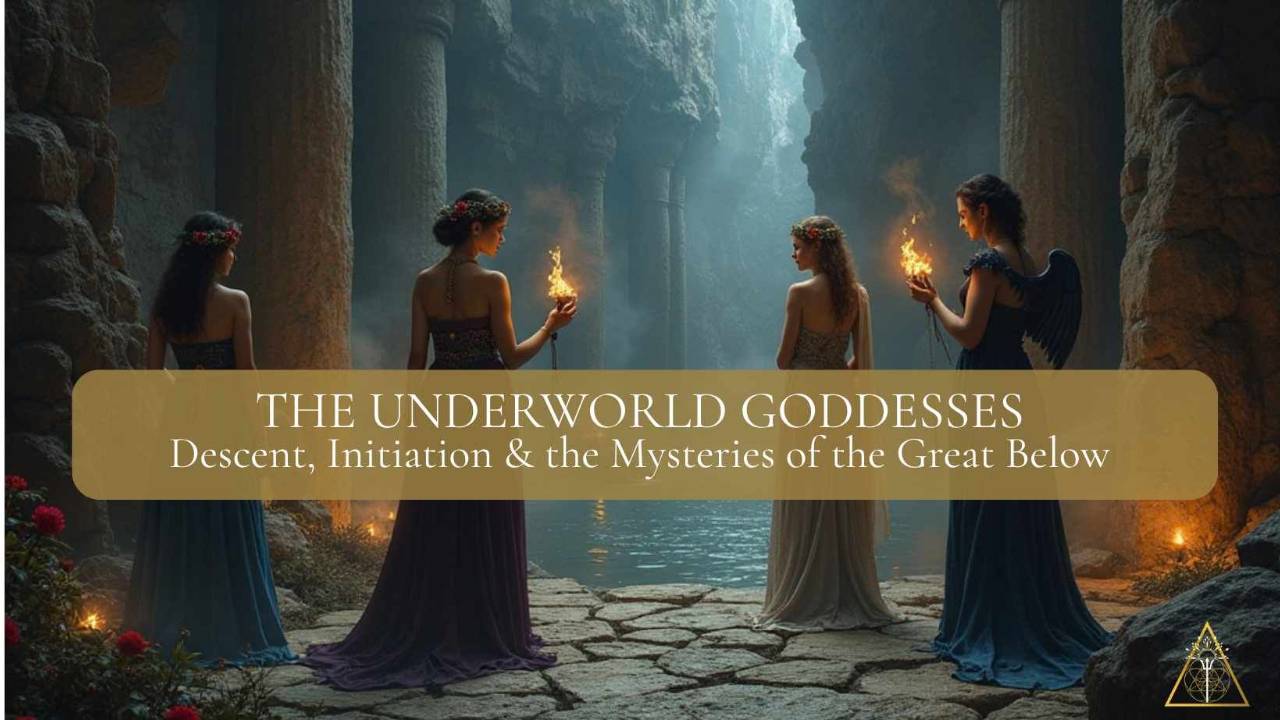
There is something about October that naturally draws us toward the mysteries. The days become shorter, the air changes, the natural world begins its descent into stillness, and we move closer to Samhain, a time traditionally associated with the ancestors, the Otherworld and the thinning of the veil.
This year we have another layer woven into October through Venus Retrograde, which has had me thinking about the goddesses of the ancient world who were connected with descent, death, transformation and the Underworld.
When we begin looking across ancient civilizations, we find some incredibly powerful stories. There are goddesses who descend willingly into the Underworld, goddesses who become its queens, goddesses who stand at the threshold between worlds and others who guide, mourn or protect the dead. Their stories are different, and I think it is important that we honour those differences rather than trying to turn them all into versions of the same archetype.
At the same time, there is something fascinating about placing these stories beside one another and asking what the ancient people who told them understood about descent.
So maybe this marks the perfect place to begin this October... with the ancient Goddess of Venus herself.
Inanna and the Seven Gates of the Underworld
Thousands of years before the Roman goddess Venus, the people of ancient Mesopotamia were already observing the brilliant planet in the sky and associating it with the goddess Inanna, later known as Ishtar.
Inanna was connected with love, sexuality, fertility, power and warfare, and her celestial identity was closely associated with Venus as the Morning and Evening Star. This makes her particularly interesting to return to during Venus Retrograde, because one of her most famous stories takes the Goddess of Venus out of the heavens entirely and brings her into the depths of the Underworld.
In the ancient Sumerian Descent of Inanna, Inanna journeys into the Great Below, the realm ruled by her sister Ereshkigal. To enter, she must pass through seven gates, and at each one she is required to remove something she carries: her crown, jewellery, garments and the symbols associated with her position and authority.
By the time Inanna reaches the deepest realm, everything that outwardly identified her as the powerful Queen of Heaven has been stripped away.
This is where I think the story becomes especially interesting from a mystery school perspective. We can study the mythology within its ancient Mesopotamian context, while also allowing ourselves to contemplate what the image of the Seven Gates might mean for us. What happens when the identities, titles and things we use to define ourselves can no longer accompany us? What remains when we arrive at the deepest gate?
Inanna's descent ultimately leads to her death and, later, her restoration and ascent. It is a powerful ancient story of crossing into another realm and returning changed by what has taken place there.
During Venus Retrograde, there is something particularly beautiful about returning to this myth. Venus already invites us to reconsider our relationships with love, beauty, pleasure, creativity, worth, abundance and what we truly value. Inanna takes us even deeper by asking what happens when the Goddess associated with Venus herself descends beneath the surface.
Ereshkigal, Queen of the Great Below
Waiting for Inanna in the Underworld is her sister, Ereshkigal, and she is a goddess I think deserves much more attention than she often receives.
It would be easy to read the story of Inanna's descent and make Ereshkigal the villain, but that misses much of what makes her so compelling. Ereshkigal is the sovereign Queen of the Great Below. Inanna is entering her realm, and that realm has its own laws.
Even the Queen of Heaven cannot enter the Underworld unchanged.
There is a different kind of feminine power represented by Ereshkigal. Her sovereignty does not depend upon ascending into the heavens or becoming a goddess of light. She rules from within the depths, which gives us an opportunity to explore the sacred feminine beyond the forms in which we usually encounter her.
This is one of the reasons I am so drawn to the Underworld Goddesses for October. So much spiritual language focuses on ascending, expanding and reaching toward greater light, yet the ancient mysteries repeatedly remind us that wisdom can also be found through descent. There are times when the journey moves inward and downward, into the places we have yet to fully understand.
Persephone and the Mystery of Returning
When we move from ancient Mesopotamia into Greece, we encounter another Queen of the Underworld through Persephone.
Her story is not the same as Inanna's, and I don't want to treat the two descents as interchangeable. In the Homeric Hymn to Demeter, Persephone is taken by Hades into the Underworld, and the grief of her mother Demeter becomes central to what unfolds. Eventually Persephone is able to return, although because she has eaten the seeds of the pomegranate, she will continue to spend part of the cycle below.
Persephone therefore becomes a goddess who belongs, in a sense, to two worlds. She knows the world above and the world below, and her movement between them became intertwined with some of the most profound sacred mysteries of ancient Greece.
The Eleusinian Mysteries, centred upon Demeter and Persephone, endured for centuries and were among the most important initiatory traditions of the ancient Mediterranean world. Although much of what happened within the initiations was deliberately kept secret, we know that the mysteries engaged deeply with questions surrounding life, death and what may await us beyond it.
This makes Persephone particularly beautiful to explore as we move toward Samhain. Her story reminds us that the Underworld is not simply a destination from which nothing returns. Within her mythology there is movement between realms, and with that movement comes an intimate knowledge of both.
Hecate at the Threshold
Hecate enters Persephone's story in a way that I have always found beautiful. In the Homeric Hymn to Demeter, she hears Persephone's cries and later approaches Demeter carrying torches. After Persephone's return, Hecate becomes closely associated with her.
As Hecate's traditions developed, she became increasingly connected with crossroads, boundaries, spirits, magic and liminal spaces. She is a goddess who knows how to stand at the threshold, which makes her especially relevant as we approach the end of October.
Hecate is Greek and does not belong to the Celtic tradition of Samhain, so I don't want to blur those traditions together. What we can do, however, is explore the resonance between them. Samhain brings us to a seasonal threshold, while Hecate gives us an ancient goddess whose mysteries include the crossing of boundaries and the spaces between worlds.
There is something very fitting about allowing her torches to accompany us into this particular exploration.
Nephthys and the Sacred Care of the Dead
Our journey then takes us into ancient Egypt and to Nephthys, whose relationship with death brings a very different dimension into the class.
Nephthys appears within the Osirian cycle alongside her sister Isis and is closely associated with mourning, funerary traditions and protection of the deceased. Together, Isis and Nephthys mourn Osiris and participate in the sacred story surrounding his restoration.
What I love about bringing Nephthys into this conversation is that she allows us to explore something beyond the descent itself. She brings us into the sacred relationship between the living and the dead, and into the rituals through which ancient people continued to honour and care for those who had crossed beyond the physical world.
As Samhain approaches, this feels especially meaningful. So many ancient cultures maintained relationships with their ancestors and understood remembrance as something active and sacred. The people who came before us remained part of the family, the lineage and the spiritual landscape.
Nephthys gives us another way of approaching the mysteries of October: through remembrance, reverence and the sacred act of tending what has passed beyond our sight.
Entering the Underworld Mysteries
The more I sit with these goddesses together, the more I feel that the Underworld is the real thread connecting this October journey.
Inanna shows us the descent through the Seven Gates, while Ereshkigal introduces us to the sovereign power that already resides below. Persephone moves between worlds, Hecate stands at the threshold, and Nephthys brings us into relationship with death, mourning and those who have crossed beyond the physical realm.
Each comes from her own culture and carries her own history, but together they give us a remarkable opportunity to explore how different ancient civilizations approached mysteries that humanity is still contemplating today.
October feels like the perfect time to enter these teachings. The natural world around us is moving through its own cycle of descent, Venus Retrograde draws our attention back toward the heart and what we value, and Samhain brings us toward an ancient seasonal threshold associated with the ancestors and the Otherworld.
Rather than seeing darkness as something separate from spiritual life, perhaps this season can remind us that there is wisdom within the descent as well. There are times to reach toward the light, and there are times to carry a torch with us into the mysteries and discover what is waiting there.
Join Me for The Underworld Goddesses
This exploration will become our next live class inside Galactic Temples of Light on October 14 while it's replay will always live within the GTOL library.
The Underworld Goddesses: Descent, Initiation & the Mysteries of the Great Below will take us through ancient Mesopotamia, Greece and Egypt as we explore Inanna, Ereshkigal, Persephone, Hecate and Nephthys in much greater depth.
We will explore their mythology and the civilizations from which their stories emerged, but as always within Galactic Temples of Light, we will also enter the mysteries experientially. I want us to explore the Seven Gates of Inanna, the ancient connection between Inanna and Venus, the approaching threshold of Samhain and what the Underworld can teach us about initiation, transformation and our relationship with the unseen.
Galactic Temples of Light is my ever-growing mystery school library, with more than 120 classes held within the Temples of Ancient Civilizations, Stars and Time. Every month we gather for a new live class, while members also have access to the extensive library of teachings and journeys that have been created over the years.
If these mysteries are calling to you, I would love to welcome you into the Temple and have you join us live on October 14.
Join Galactic Temples of Light and enter the mysteries with us.
Love
Priscilla
Founder of the Temples of Atlantis Mystery School
SUBSCRIBE FOR WEEKLY LIFE LESSONS